

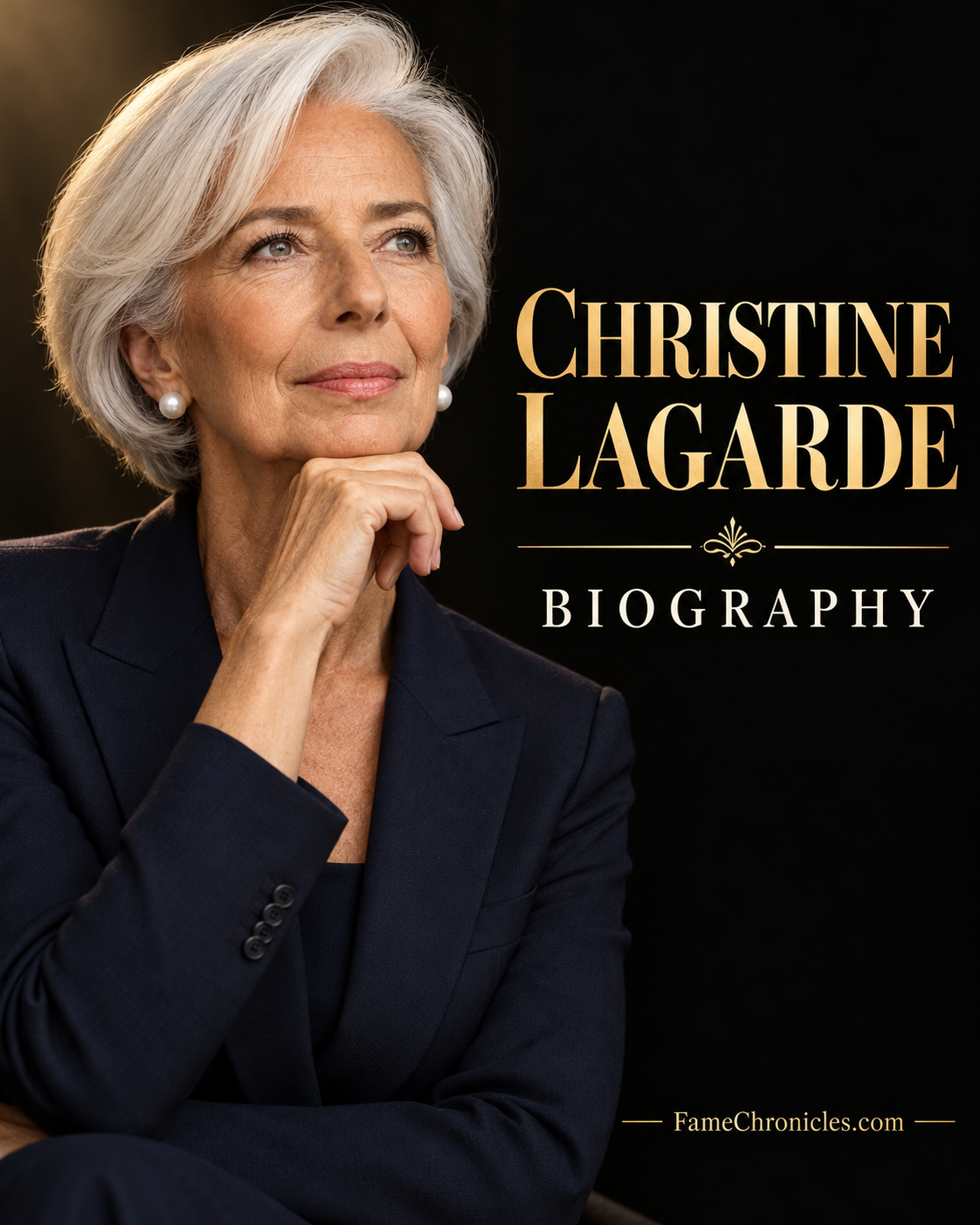
Christine Lagarde is a French lawyer and public official who leads the European Central Bank (ECB). Before becoming ECB president, she headed the International Monetary Fund (IMF) and served as France’s finance minister. Her career has taken her from international law to national government and the institutions that help shape the global economy.
Born in Paris on January 1, 1956, Lagarde is 70 years old as of October 2026. She became the first woman to lead both the IMF and the ECB. In those roles, she has been a prominent public voice during periods of financial uncertainty, although the institutions’ decisions are made through formal governing bodies rather than by their presidents alone. European Central Bank
Christine Lagarde quick facts
| Detail | Information |
|---|---|
| Full name | Christine Lagarde |
| Born | January 1, 1956 |
| Birthplace | Paris, France |
| Age | 70 (as of October 2026) |
| Nationality | French |
| Profession | Lawyer and public official |
| Education | University Paris X; Sciences Po Aix; Avignon Art College |
| Early career | International commercial lawyer |
| Law firm leadership | Global chair of Baker McKenzie |
| French government role | Minister of Economy and Finance, 2007–2011 |
| IMF role | Managing Director, 2011–2019 |
| Current role | President of the European Central Bank, since 2019 |
| Children | Two sons |
| Sports background | Former member of France’s national synchronized swimming team |
Who is Christine Lagarde?
Lagarde is best known for her leadership at the ECB, the central bank responsible for monetary policy in the euro area. She took office in November 2019, after serving eight years as managing director of the IMF. Before that, she held senior posts in the French government and built a long career as a lawyer at the international firm Baker McKenzie. European Central Bank
Her path is distinctive because it crosses three fields that are often treated separately: law, elected-government administration, and central banking. That experience has made her a highly visible figure in discussions about inflation, interest rates, financial stability, and international cooperation.
The ECB president does not make monetary policy alone. The ECB’s Governing Council sets policy for the euro area, including decisions about key interest rates. As president, Lagarde chairs the institution’s central decision-making work and communicates its decisions to the public. The ECB’s primary monetary-policy objective is price stability. ECB on monetary policy
Early life and education
Christine Lagarde was born in Paris and attended school in France and the United States. She completed high school in Le Havre and spent time as an exchange student at Holton-Arms School in Bethesda, Maryland. Her education combined law, economics, finance, and literature.
She studied at University Paris X, where she earned qualifications in commercial and labor law. She also earned a master’s degree in economics and finance from Sciences Po Aix and studied American literature at Avignon Art College, according to the ECB’s official biography. European Central Bank
Before entering public life, Lagarde was a competitive synchronized swimmer and a member of France’s national team. That detail is a reminder that her career began long before she became a familiar face in global financial news. Her professional story started in law, where she developed expertise in commercial matters involving companies operating across national borders. International Monetary Fund
Career as a lawyer
Lagarde joined Baker McKenzie in 1981 and worked primarily in commercial law, mergers and acquisitions, antitrust, labor law, and arbitration. She rose through the firm’s leadership, joining its global executive committee in 1995 and becoming global chair in 1999. She led the organization until 2005, when she moved into French government service. European Central Bank
Her legal career gave her experience in negotiations and complex business disputes before she took on public responsibilities. It also made her unusual among politicians and central-bank leaders, many of whom began their careers in government or economics. Lagarde’s professional background was in international corporate law, and she later brought that perspective to economic policy.
Entering French politics
Lagarde entered the French government in 2005 as minister for foreign trade. In 2007, she briefly served as minister of agriculture and fisheries before becoming minister of economy and finance. She was the first woman to hold that finance-and-economy portfolio in a G7 country. IMF biography
Her time in office coincided with the global financial crisis, which began in 2007 and intensified in 2008. As France’s finance minister, she took part in national and international discussions about financial regulation and economic coordination. She also chaired the European Union’s ECOFIN Council during France’s EU presidency and later participated in work related to France’s 2011 presidency of the G20.
The role placed her in a demanding position: finance ministers must respond to immediate economic pressures while also negotiating with other governments and institutions. Lagarde’s public profile grew during this period, and she became an internationally recognized voice on economic issues.
Leading the International Monetary Fund
In July 2011, Lagarde became managing director of the IMF, succeeding Dominique Strauss-Kahn. She was the first woman to lead the organization. She was reappointed in 2016 and remained in the position until 2019, when she left after being nominated to lead the ECB. IMF
The IMF works with member countries on international monetary cooperation, financial stability, and economic challenges. As managing director, Lagarde represented the institution, led its staff, and helped direct its work with governments around the world. Her tenure included debates over sovereign debt, financial crises, and the impact of economic policies on different countries.
The IMF role gave her a global platform, but it also put her at the center of difficult policy choices. IMF programs and recommendations can attract criticism from governments, economists, and the public, especially when they involve financial assistance or economic reforms. Lagarde’s time at the organization therefore involved both institutional leadership and public scrutiny.
President of the European Central Bank
Lagarde became president of the ECB in November 2019. The ECB helps manage the euro and sets monetary policy for the countries that use it. Its Governing Council makes decisions about monetary objectives and key interest rates; the president chairs the ECB’s governing work and represents the institution publicly. European Central Bank
Her tenure has included major economic disruptions, including the COVID-19 pandemic, sharp inflation, and changes in energy prices. These events have made the ECB’s task especially challenging: monetary policy must respond to price pressures while considering the broader economic effects of interest-rate decisions.
For readers, one practical way to understand Lagarde’s role is to distinguish between leadership and sole control. She is the most visible ECB official, but interest-rate decisions are made by the Governing Council. The ECB describes price stability as its primary objective and aims for inflation of 2% over the medium term. ECB’s price-stability explanation
The Tapie arbitration case
Lagarde’s record also includes a legal controversy from her time as France’s finance minister. In 2016, a special French court found her guilty of negligence related to her handling of a state arbitration award to businessman Bernard Tapie. The court did not impose a sentence. Lagarde denied wrongdoing and remained IMF managing director at the time. Reuters report carried by Euronews
The case concerned a large state payment arising from a dispute involving Tapie and Crédit Lyonnais. The court’s finding related to Lagarde’s failure to challenge the arbitration award. It is an important part of her public record and is best described precisely: she was found guilty of negligence, but the court issued no sentence.
Personal life
Lagarde has two sons. She has generally kept her family life more private than her professional activities, so reliable public biographies focus primarily on her education and career rather than offering extensive personal details. The IMF’s biographical information confirms that she is the mother of two sons. International Monetary Fund
Her sports background is one of the more personal details she has shared in official profiles. As a young woman, she competed in synchronized swimming for France. That early commitment to training preceded the demanding path she later followed through law, business, government, and international institutions.
Why Christine Lagarde is significant
Lagarde’s career is significant partly because she became the first woman to lead two major global financial institutions: the IMF and the ECB. Those appointments reflected a career that had already spanned private-sector leadership and national public service.
Her biography also offers a view into how international economic leadership works. The ECB and IMF have different responsibilities, and their leaders operate within boards and governing structures. The public may associate decisions with the person at the top, but the institutions rely on collective decision-making and formal mandates.
Lagarde’s professional path has drawn both recognition and criticism. Supporters point to her leadership and ability to represent financial institutions on the world stage. Critics scrutinize policy decisions and the consequences of international financial programs. A balanced biography should make space for both her professional achievements and the controversies attached to public office.
Frequently asked questions
How old is Christine Lagarde?
Christine Lagarde was born on January 1, 1956. She is 70 years old as of October 2026.
What is Christine Lagarde’s current job?
She is president of the European Central Bank, a position she has held since November 2019. The ECB’s Governing Council makes monetary-policy decisions for the euro area.
Was Christine Lagarde the head of the IMF?
Yes. She served as managing director of the International Monetary Fund from July 2011 to September 2019 and was the first woman to hold the position.
What did Christine Lagarde do before joining the IMF?
Before leading the IMF, she was France’s minister of economy and finance. Earlier, she worked as an international lawyer and became global chair of Baker McKenzie.
What is Christine Lagarde’s education?
Her studies included commercial and labor law at University Paris X, economics and finance at Sciences Po Aix, and American literature at Avignon Art College.
Was Christine Lagarde involved in a court case?
Yes. In 2016, a French court found her guilty of negligence over her handling of the Bernard Tapie arbitration award. The court did not impose a sentence.
Final Word
Christine Lagarde’s career has taken her from international law to France’s finance ministry, the IMF, and the European Central Bank. She is a historically significant leader who has worked at the center of global economic debates. Her story includes major firsts, demanding public responsibilities, and a legal controversy that remains part of her record.