

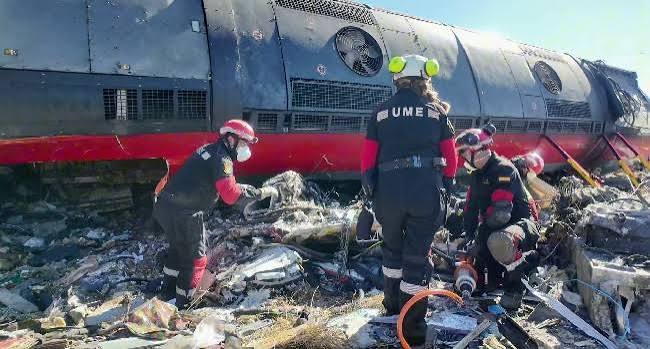
A deadly collision between two high-speed trains in central Spain has killed at least 68 people and injured dozens, according to officials cited in reports published on October 28 and 29, 2026. The crash happened near Urda, in Toledo province, on the high-speed route linking Madrid with southern Spain.
The trains were travelling south from Madrid when a Renfe-operated train struck the rear of a stationary Iryo train. The impact derailed carriages on both trains. Emergency crews searched the wreckage, transported injured passengers to hospitals, and helped other survivors leave the scene.
Authorities have described a possible sequence involving a technical failure and a decision to allow one train to continue. However, the investigation is ongoing. That account should be treated as a preliminary explanation, not a final finding about the cause or responsibility. Associated Press Euronews
Spain train crash: Key facts
| Detail | Information reported |
|---|---|
| Date | October 28, 2026 |
| Location | Near Urda, in Toledo province, Castilla-La Mancha, Spain |
| Trains involved | A Renfe-operated train and an Iryo-operated train |
| Direction of travel | Southbound from Madrid toward Seville |
| Confirmed deaths | At least 68, according to regional officials cited in reports on October 28–29 |
| Injuries | Dozens; published totals differ as reporting and hospital updates develop |
| Reported collision | The Renfe train struck the rear of the stopped Iryo train |
| Investigation | Authorities are examining the signalling and control decisions before the collision |
| Rail disruption | Services on the Madrid–Andalusia route were suspended |
What happened in the collision?
The crash occurred on the high-speed railway in Toledo province, between the towns of Urda and Los Yébenes. The trains were travelling in the same general direction, from Madrid toward Seville. According to the Associated Press, one train operated by Renfe hit the rear of an Iryo train that had stopped on the track. The collision derailed carriages at the rear of the Iryo train and the front of the Renfe train.
The precise timeline and technical details remain subject to investigation. Spain’s transport minister, Óscar Puente, said a railway safety system had stopped trains after a computer-related malfunction. He said the control centre later authorised the Renfe train to resume its journey, although a stop signal remained active. Investigators will need to establish exactly what signals were displayed, what instructions were given, and how the trains responded.
Those statements are preliminary information from officials. They do not, by themselves, establish criminal or legal responsibility. The rail incident investigation will need to examine technical records, communications, signalling data, and other evidence before conclusions can be confirmed.
Deaths, injuries, and rescue work
The regional government of Castilla-La Mancha confirmed at least 68 deaths in reports published shortly after the crash. Many more people were injured, with news accounts reporting different hospital totals as authorities continued to provide updates. Because this is a recent disaster, figures may change as identification and medical assessments continue.
Emergency responders worked through the wreckage to reach passengers and search for people who might still need help. Ambulances and medical helicopters transported injured people, while other survivors were taken away from the scene by bus. The Associated Press reported that a military emergency unit also joined the response.
The collision caused extensive damage to train cars. Passengers described a sudden impact and carriages being thrown off balance. Their accounts illustrate the experience of people aboard, but they do not determine the cause of the crash; that is for investigators to establish.
What investigators are examining
Transport Minister Puente said investigators were looking at a sequence that began with a failure in a safety system. According to his account, the system stopped trains along a section of track, after which the Renfe train was permitted to continue. He said the train should not have been authorised to resume normal speed while a stop signal remained active.
This is an early account, and further evidence may clarify or revise it. Investigators are expected to look at the signalling system, control-centre records, the timeline of instructions, train data, and the condition of the infrastructure. They will also need to determine whether the trains’ onboard safety equipment functioned as intended.
It is important not to present a preliminary statement as a settled cause. In major rail accidents, the final findings usually depend on technical analysis and a full review of operational procedures. Until authorities publish more complete results, the explanation should be attributed to the officials who have made it.
Rail service disruption and public response
Rail traffic on the high-speed route connecting Madrid with parts of southern Spain was suspended after the collision. The disruption affected services between Madrid, Ciudad Real, and Andalusia, according to reports from the Associated Press. Passengers planning journeys should check directly with rail operators for current service information, as schedules and reopening details can change.
Prime Minister Pedro Sánchez visited the crash site and announced three days of national mourning. King Felipe VI also expressed condolences to those affected. The crash has prompted renewed attention to railway safety, particularly because Spain suffered another deadly train collision earlier in 2026.
The two incidents are separate events. The January crash occurred in southern Spain and killed 46 people, according to the Associated Press. Similarities in the operators involved have drawn attention, but the earlier collision does not establish the cause of the Urda crash. Each incident requires its own investigation and evidence-based conclusions.
Why this crash is receiving international attention
Spain has one of Europe’s largest high-speed rail networks, and its trains are used by residents and visitors travelling between major cities. A collision involving two passenger trains, a high number of casualties, and widespread disruption has therefore drawn international attention.
The timing has also raised questions about the safety systems and procedures that govern train movements. Those questions are important, but answers should follow the evidence. Public statements and eyewitness accounts can help establish what people experienced and what officials know so far; investigators must determine how the events fit together.
What is confirmed—and what remains unknown
As of reports published on October 28 and 29, authorities had confirmed that two trains collided near Urda, that at least 68 people died, and that many passengers were injured. Officials said the trains were travelling south from Madrid and that the Renfe train struck a stopped Iryo train.
The full cause, the exact sequence of control-centre decisions, and any individual or institutional responsibility had not yet been established in a final investigation report. Injury totals and service updates may also change. Readers should rely on dated reports and official updates for new information rather than repeating unverified claims circulating online.
Frequently asked questions
Where did the Spain train crash happen?
The collision happened near Urda, in Toledo province, in the Castilla-La Mancha region of central Spain.
When did the train collision occur?
It occurred on October 28, 2026, on the high-speed route connecting Madrid with southern Spain.
How many people died?
Officials cited in reports published on October 28 and 29 confirmed at least 68 deaths. Because the incident is recent, updates should be checked for any revised totals.
Which trains were involved?
A Renfe-operated train collided with a stationary Iryo-operated train, according to the Associated Press.
What caused the crash?
The final cause has not been established. Spain’s transport minister described a possible sequence involving a safety-system failure and a decision to let the Renfe train resume its journey. Investigators are examining the circumstances.
Are trains running between Madrid and Andalusia?
Services on the route were suspended after the crash. Check Renfe, Iryo, and rail-network operator Adif for current service notices before travelling.
Final Word
The October 28 collision near Urda is one of Spain’s deadliest recent rail disasters. Authorities have confirmed a high death toll, injuries, and major disruption to high-speed services. While officials have outlined a possible sequence involving a system failure and a control-centre decision, the investigation must establish what happened and why. Until its findings are available, reporting should distinguish confirmed facts from preliminary explanations.