

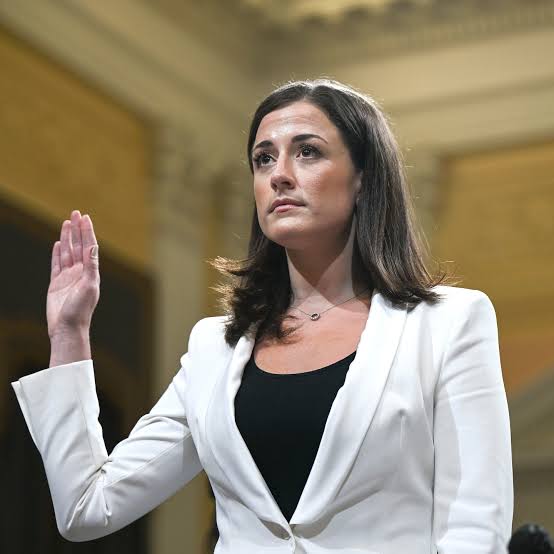
Cassidy Hutchinson is a former White House aide who became a prominent witness in the congressional investigation of the January 6, 2021, attack on the U.S. Capitol. She worked for White House Chief of Staff Mark Meadows during Donald Trump’s first administration and testified publicly before the House Select Committee investigating January 6 in June 2022.
Her testimony drew intense national attention because she described conversations and events inside the White House during the days around the attack. Some parts of her account were based on what other officials had told her, and one account about Trump’s behavior inside a presidential vehicle was later disputed by a Secret Service agent. On October 27, 2026, a federal grand jury declined to indict Hutchinson in connection with her January 6 testimony, according to news organizations citing people familiar with the matter. Associated Press report
This profile summarizes Hutchinson’s background, White House work, congressional testimony, memoir, and current public status. It separates her testimony and disputed claims from findings established in official records.
Cassidy Hutchinson at a Glance
| Detail | Information |
|---|---|
| Name | Cassidy Hutchinson |
| Known for | Serving as a White House aide and testifying to the January 6 House committee |
| White House role | Special assistant to the president and aide in the chief of staff’s office |
| Chief of staff she worked for | Mark Meadows |
| Earlier political experience | Internships and work connected to Republican lawmakers |
| January 6 public testimony | June 28, 2022 |
| Memoir | Enough, published in 2023 |
| Hometown | Pennington, New Jersey |
| Latest legal development | A federal grand jury declined to indict her on October 27, 2026, according to reports |
| Age | Not stated here because a reliable birth date was not established in the sources cited |
Early Life and Education
Cassidy Hutchinson was born and raised in Pennington, New Jersey, according to her publisher’s biography. Before working at the White House, she gained experience in Republican politics through internships with lawmakers, including Representative Steve Scalise and Senator Ted Cruz. She later worked in the White House Office of Legislative Affairs. Simon & Schuster author biography
Public information about her personal background is limited compared with the extensive coverage of her government service and testimony. Her public profile largely developed through her proximity to senior White House staff and her role in the January 6 investigation.
Work in the Trump White House
Hutchinson joined the White House Office of Legislative Affairs in 2019. In March 2020, she moved to the Office of the Chief of Staff and served as a special assistant to the president and an aide to Mark Meadows. Her responsibilities included contact with members of Congress, senior officials, and policy staff. Those details are reflected in her congressional testimony and in the published hearing record. House hearing transcript
The role placed Hutchinson near the center of White House operations during the final months of Trump’s first term. She worked in a small office closely connected to the president and his chief of staff, which gave her access to conversations and developments relevant to the committee’s inquiry.
Her position did not make her the decision-maker on every issue she later discussed. Some of her testimony concerned events she said she personally observed; other details were accounts relayed to her by colleagues. That distinction became important in public discussion of her testimony.
January 6 Committee Testimony
On June 28, 2022, Hutchinson testified publicly before the House Select Committee investigating the January 6 attack. The hearing was announced shortly beforehand and became one of the committee’s most widely watched sessions.
Hutchinson described the atmosphere in the White House leading up to January 6 and testified about conversations involving Meadows and other officials. She said that senior staff had been warned about the possibility of violence and that Trump had been told some rally attendees were armed. In discussing those warnings, she made clear that some information had been relayed to her by other officials rather than witnessed firsthand. The committee’s final report records that distinction in its account of the evidence. January 6 committee final report
She also testified about an account she said Deputy Chief of Staff Anthony Ornato had given her concerning Trump’s reaction after the Secret Service refused to take him to the Capitol. Hutchinson said Ornato described Trump as angry and recounted an alleged physical confrontation inside the presidential vehicle. Hutchinson was not in the vehicle herself; her account of that incident was based on what she said Ornato told her.
The account became one of the most widely discussed parts of the hearing. In 2024, House Republicans released a transcript of an interview with a Secret Service officer who drove the vehicle. The driver disputed the description of Trump lunging toward the steering wheel or a Secret Service agent. News reports noted that the driver said Trump was visibly angry but did not behave as Hutchinson described. Associated Press coverage of the later transcript
Hutchinson’s testimony also described her experience preparing to speak with the committee, including her account that she felt pressure to limit what she shared. Her former lawyer disputed her characterization of his conduct. These competing accounts were part of the public record and should be presented as such.
A Witness in a Politically Divided Debate
Hutchinson’s testimony made her a central figure in a sharply divided political debate. Supporters of the committee viewed her as a significant witness because of her proximity to Meadows and the White House. Trump and his allies criticized her account, particularly the secondhand details concerning the presidential vehicle.
The committee’s findings drew on a wider body of testimony, documents, and records. Hutchinson’s account was one part of that investigation, not the only evidence considered. Readers should distinguish among what she personally saw, what she said others told her, and conclusions later drawn by the committee.
The controversy also affected Hutchinson personally. In her memoir and interviews, she described intense public criticism and pressure after her testimony. The scale of the response reflected how closely her account touched on the conduct of a president and his inner circle during a national crisis.
Memoir: Enough
Hutchinson published her memoir, Enough, in September 2023. The book recounts her experience working in the Trump White House, her decision to cooperate with the January 6 committee, and the personal and political consequences of her testimony. It also describes her changing view of the people around her and her struggle over whether to speak publicly. The publisher describes it as her first book. Simon & Schuster
The memoir became part of the broader record of the Trump administration and the January 6 investigation. As with any memoir, it presents the author’s perspective and recollection. Its claims can be compared with transcripts, official reports, and other witnesses’ accounts.
The 2026 Grand Jury Decision
In October 2026, news organizations reported that federal prosecutors had sought an indictment against Hutchinson related to her January 6 testimony. On October 27, a federal grand jury in Washington declined to indict her, according to people familiar with the proceedings who spoke to the Associated Press and other outlets. The Justice Department had not publicly detailed the proposed charges at the time of those reports. Associated Press
A grand jury’s decision not to indict means prosecutors did not secure an indictment in that presentation. It is not a trial verdict, and it does not by itself settle every factual dispute surrounding Hutchinson’s testimony. Likewise, criticism of her testimony is not equivalent to a criminal finding that she lied.
The development is an important update to her public biography, but it does not change the historical record of her role as a White House aide or as a witness before Congress. If later court or Justice Department records provide additional information, this section should be updated.
Frequently Asked Questions
Who is Cassidy Hutchinson?
Cassidy Hutchinson is a former White House aide who worked for Chief of Staff Mark Meadows and testified publicly before the House committee investigating the January 6, 2021, Capitol attack.
What was Cassidy Hutchinson’s White House job?
She worked in the White House Office of Legislative Affairs and later served as a special assistant to the president and an aide in the chief of staff’s office.
What did Cassidy Hutchinson testify about?
She testified about events and conversations in the White House around January 6, including warnings about potential violence and what she said other officials told her about Trump’s actions that day. Some parts of her testimony were based on secondhand accounts.
Was the presidential vehicle account disputed?
Yes. Hutchinson said she had been told Trump lunged toward the steering wheel and a Secret Service agent. The driver later disputed that description in an interview, while saying Trump had been visibly angry.
Did Cassidy Hutchinson write a book?
Yes. Her memoir, Enough, was published by Simon & Schuster in 2023. It recounts her work in the White House and her decision to testify to the January 6 committee.
Was Cassidy Hutchinson indicted in 2026?
News organizations reported that a federal grand jury declined to indict her on October 27, 2026, in a case related to her January 6 testimony. The proposed charges were not publicly detailed in the reports cited here.
How old is Cassidy Hutchinson?
A reliable birth date was not established in the sources cited for this profile, so an age is not included.
Final Word
Cassidy Hutchinson became a major public figure because of her role inside the Trump White House and her testimony to the January 6 committee. Her account contributed to the public record, while some details—especially her description of events inside the presidential vehicle—were disputed by other witnesses.
Her memoir, Enough, offers her own account of that period and its personal consequences. In October 2026, a grand jury declined to indict her over her testimony, according to news reports. A careful biography should preserve these distinctions: her documented government roles, her attributed testimony, the disputes over parts of that testimony, and the latest reported legal development.