

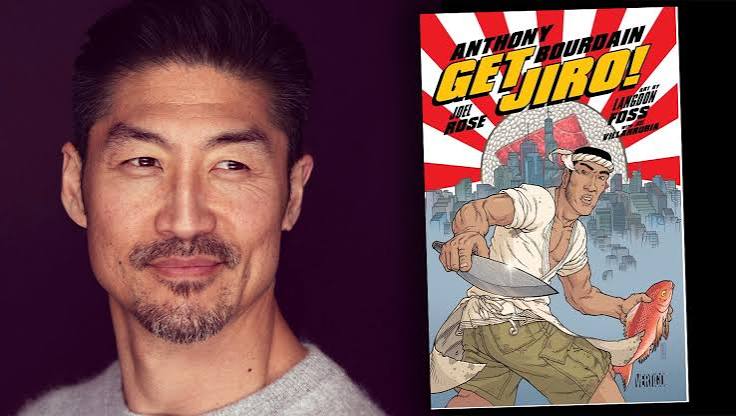
The book combines action, dark comedy, food writing, and social satire. Its exaggerated violence is part of its comic-book style, but the central target is recognizable: the way food can become a marker of status, identity, taste, and cultural authority. Bourdain and Rose turn restaurant culture into a dystopian conflict in which chefs are treated like crime bosses and diners can be drawn into the struggle.
DC released the original hardcover in 2012, followed by a paperback edition. A prequel, Get Jiro: Blood and Sushi, later explored Jiro’s background. In 2026, DC published Get Jiro! The Complete Collection, which brings the two stories together.
Get Jiro! at a glance
| Detail | Information |
|---|---|
| Title | Get Jiro! |
| Format | Graphic novel |
| Original publisher | Vertigo, an imprint of DC Comics |
| Original hardcover release | 2012 |
| Paperback edition | 2013 |
| Writers | Anthony Bourdain and Joel Rose |
| Original graphic novel artist | Langdon Foss |
| Colorist | José Villarrubia |
| Letterer | Todd Klein |
| Setting | A dystopian, near-future Los Angeles |
| Main character | Jiro, a master sushi chef |
| Related prequel | Get Jiro: Blood and Sushi |
| Complete collection release | June 30, 2026 |
| Complete collection contents | Get Jiro! and Get Jiro: Blood and Sushi |
| Recommended audience | Mature readers |
What is Get Jiro! about?
The story takes place in a future Los Angeles where food culture has grown into a form of political and social power. Two broad culinary movements dominate the city. The Internationalists embrace mixtures of cuisines and elaborate combinations, while the Vertical Farm faction promotes organic, vegetarian, and macrobiotic food. Their competition is not limited to menus or restaurant reviews: the factions behave like rival power groups in a city where a chef’s influence can determine who controls the dining scene.
Jiro is a sushi chef whose skill and reputation make him valuable to both sides. The factions want him to join their cause, but he is not interested in being controlled by either one. He has his own standards for food and his own view of what a good meal should be. His independence puts him in danger as the culinary conflict escalates.
The book’s premise deliberately pushes food-world rivalries to absurd extremes. In its Los Angeles, people may risk their lives for a seat at a famous restaurant, and chefs wield authority like gang leaders. The exaggerated setting lets the creators make fun of food snobbery, celebrity chefs, rigid ideas about authenticity, and the pressure to treat every meal as a statement about identity.
DC’s official description presents the book as a violent satire of food culture. The comedy comes partly from the gap between familiar restaurant arguments and the extraordinary consequences the story assigns to them. The book is not a realistic account of professional kitchens; it uses a crime-story framework and graphic-novel exaggeration to make its points.
Who created Get Jiro!?
Anthony Bourdain co-wrote Get Jiro! with Joel Rose. Bourdain was a chef, bestselling author, and television host whose books and programs often examined kitchens, food traditions, and the people who worked in restaurants. Rose is a novelist and writer who collaborated with Bourdain on several comics and graphic novels.
Langdon Foss illustrated the original book. His artwork gives the story its visual world, from restaurant interiors and city settings to the confrontations between culinary factions. José Villarrubia handled the colors, and Todd Klein contributed lettering. Comic storytelling depends on the combined work of writers and artists: dialogue, panel composition, color, and pacing all shape how a scene reads.
Bourdain’s background in food gives the story a particular perspective. The book is full of references to cooking and dining, but it also pokes fun at the way food can become a performance. It is interested in both the craft of cooking and the culture that surrounds chefs, restaurants, critics, and diners.
The book’s satire and themes
Get Jiro! takes familiar arguments about food and turns them into a dystopian struggle. The two factions represent competing ways of talking about cuisine: one values global combinations and novelty, while the other emphasizes purity, health, and strict principles. The comic exaggerates both positions rather than treating one side as an uncomplicated hero.
That approach lets the story ask how taste becomes tied to status. In real life, restaurants and food trends can signal wealth, education, cultural knowledge, or membership in a particular community. In the book, these social distinctions are made literal and dangerous. The comic’s outrageous world is a way to examine the seriousness with which people sometimes defend their preferences.
The story also focuses on artistic independence. Jiro is not simply choosing between two menus or restaurant styles; he is deciding whether to let powerful groups define his work. His skill gives him leverage, but it also makes him a target. The tension between craft and control runs through the plot.
Because the graphic novel is intentionally violent, its satire is not subtle in every scene. The humor can be broad and shocking, and the story’s premise is meant for mature readers. Its appeal depends partly on whether a reader enjoys dark comedy, action comics, and irreverent commentary about food culture.
Get Jiro: Blood and Sushi
Get Jiro: Blood and Sushi is a prequel that explores Jiro’s origins. DC’s description says Jiro is born into a Yakuza family but is drawn toward cooking rather than the criminal path expected of him. The story follows the collision between those worlds and the consequences of pursuing his own ambitions.
The prequel changes the emphasis from the culinary conflict of Los Angeles to Jiro’s background in Japan. It adds context to the character’s discipline and independence, while preserving the series’ blend of action, food, and stylized violence. Anthony Bourdain and Joel Rose returned as writers, with Alé Garza providing the art and Dave Johnson creating the cover.
Readers can start with the 2012 original and then read the prequel, or use the 2026 complete collection, which gathers both books. The collection provides a convenient way to follow Jiro’s story from his earlier life to the later Los Angeles setting.
The 2026 complete collection
DC published Get Jiro! The Complete Collection on June 30, 2026. The edition collects the original graphic novel and Get Jiro: Blood and Sushi, and includes new cover material and previously unseen development art by Langdon Foss. DC lists the collection at 304 pages and rates it for mature readers.
The combined edition makes the relationship between the two stories easier to follow. The prequel gives readers background on Jiro, while the original book shows him in a future Los Angeles where rival food factions seek his allegiance. Readers who already own the separate volumes may be interested in the additional development art; new readers can use the collection as a single-volume entry point.
Why Get Jiro! remains distinctive
Many comics use crime or dystopian settings to explore power. Get Jiro! stands out because it places food at the center of that world. Cooking is both the source of Jiro’s skill and the language the factions use to define themselves. The book turns culinary debates into action while keeping its focus on the people who want to control the city’s food culture.
The graphic-novel format also suits the premise. Visual art can make the world’s restaurants, kitchens, street scenes, and conflicts feel immediate. The contrast between elegant food presentation and the story’s violent comedy helps create its distinct tone. The medium lets the creators shift quickly between detailed cooking imagery and exaggerated action.
The book may especially appeal to readers who enjoy Bourdain’s irreverent writing, food satire, action comics, or stories about outsiders resisting powerful institutions. It may be less suitable for readers looking for a realistic culinary memoir or a gentle story about restaurants, because its content is deliberately graphic and its satire is sharp.
Frequently asked questions
What is Get Jiro!?
Get Jiro! is a satirical graphic novel about a master sushi chef caught between rival food factions in a dystopian version of Los Angeles.
Who wrote Get Jiro!?
Anthony Bourdain and Joel Rose co-wrote the original graphic novel.
Who illustrated Get Jiro!?
Langdon Foss illustrated the original book. José Villarrubia handled the colors, and Todd Klein provided the lettering.
When was Get Jiro! published?
The original hardcover was published by Vertigo in 2012. A paperback edition followed in 2013.
What is Get Jiro: Blood and Sushi?
It is a prequel about Jiro’s origins, including his connection to a Yakuza family and his decision to pursue cooking.
What is included in Get Jiro! The Complete Collection?
The 2026 collection includes Get Jiro! and Get Jiro: Blood and Sushi, along with additional art material.
Is Get Jiro! suitable for children?
DC rates the complete collection for mature readers. The book contains graphic violence and is not intended as a children’s comic.
Final Word
Get Jiro! turns food culture into a violent, comic-book dystopia. Anthony Bourdain and Joel Rose build a story around a sushi chef who refuses to let rival factions dictate his craft, while Langdon Foss’s art brings the strange Los Angeles setting to life. Its satire is exaggerated and intended for mature readers, but beneath the action it questions how food, status, and identity can become tangled. The 2026 complete collection brings the original story and its prequel together for readers who want Jiro’s full graphic-novel arc.