

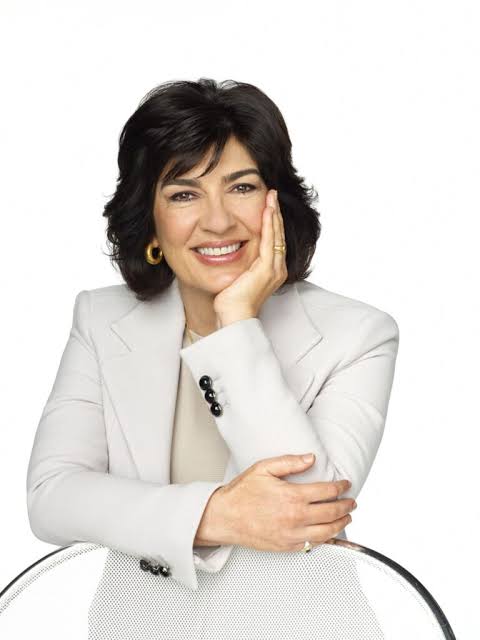
Amanpour has also hosted the CNN International program Amanpour and the PBS public-affairs series Amanpour & Company. In October 2026, she announced plans to leave CNN in June 2027 after 43 years with the network. Her career spans a period of major change in broadcast journalism, from CNN’s early years to today’s global, digital news environment.
Christiane Amanpour at a Glance
| Detail | Information |
|---|---|
| Full name | Christiane Maria Heideh Amanpour |
| Birth date | January 12, 1958 |
| Age | 68, as of October 2026 |
| Birthplace | London, England |
| Nationality and heritage | Iranian-British |
| Education | University of Rhode Island, journalism |
| Profession | Journalist, correspondent, and television host |
| Joined CNN | 1983 |
| Known for | International reporting, interviews, and global-affairs programming |
| Programs | Amanpour and Amanpour & Company |
| Major recognition | Emmy, Peabody, George Polk, and duPont-Columbia awards |
| Career announcement | Plans to leave CNN in June 2027 |
Early Life and Family Background
Christiane Amanpour was born in London on January 12, 1958, to an Iranian father and a British mother. She spent much of her childhood in Tehran, Iran, and also attended school in England. Growing up with ties to both countries gave her familiarity with more than one cultural perspective, a background she has discussed when reflecting on her work and international outlook.
Her early life included time in both Iran and the United Kingdom. That experience would later become a meaningful part of how she understood international affairs and identity. Her career, however, was not predetermined by her background. Amanpour pursued journalism as a profession and moved to the United States for university, where she studied at the University of Rhode Island.
Education and the Start of Her Journalism Career
Amanpour graduated summa cum laude from the University of Rhode Island in 1983 with a bachelor’s degree in journalism. Shortly after graduating, she joined CNN in Atlanta as an assistant on the international assignment desk. The role was an entry point into a young cable news organization, not an immediate position in front of the camera.
Her early work placed her close to the practical process of international news: coordinating assignments, supporting coverage, and learning how stories moved from the field to broadcast. She later advanced through reporting and bureau roles. The International Women’s Media Foundation describes her progression from the assignment desk to reporting positions and eventually to leading international correspondent.
Amanpour’s path is often cited as an example of a journalist rising through newsroom experience. Reporting from abroad demands research, preparation, sound editorial judgment, and the ability to work with local teams and sources under pressure. Those skills became central to the work for which she later became known.
Becoming an International Correspondent
Amanpour began reporting from major international stories during the 1980s. Her work took her to areas facing political upheaval and conflict, including Europe during the changes that preceded the end of the Cold War. By 1989, she had taken on foreign-correspondent assignments, including reporting from Frankfurt on developments in Eastern Europe.
Her visibility grew during the Gulf War in the early 1990s. She reported from the region as viewers around the world followed the conflict through continuous television news coverage. For CNN, the period was an important test of the network’s ability to deliver live international reporting. For Amanpour, it helped establish her as a correspondent willing to report from difficult and dangerous locations.
She later reported from the Balkans during the wars of the 1990s, as well as from Rwanda, Afghanistan, Iraq, Iran, Israel, the Palestinian territories, Pakistan, Somalia, and other locations. Her assignments have also included humanitarian disasters, such as Hurricane Katrina in the United States. Her reporting has covered not only battles and political decisions but also the consequences of conflict for civilians.
Reporting from Bosnia and Other Conflict Zones
Amanpour’s reporting during the Bosnian War became one of the defining parts of her career. She covered the conflict from the region during the period from 1992 to 1995, reporting on violence, displacement, and the human impact of war. The experience contributed to her reputation as a correspondent who brought international crises directly to viewers.
Her work in Bosnia also became part of broader discussions about how journalists should cover wars. Reporting from a conflict zone involves difficult decisions about access, safety, verification, and the language used to describe events. Amanpour has argued publicly for journalism that presents evidence and human consequences clearly. The Holocaust Memorial Day Trust has highlighted her coverage of the Bosnian War and her reflections on the responsibilities of reporting.
Amanpour has also covered the wars in Afghanistan and Iraq, political transitions in the Middle East, and major global crises. Her work has required balancing fast-moving live coverage with the need to explain the history and context behind the news. That combination of immediacy and analysis became a regular feature of her broadcast style.
Interviews and Television Programs
In addition to field reporting, Amanpour became known for interviewing influential figures. Her interviews have included political leaders, policymakers, human-rights advocates, and cultural figures. She has interviewed heads of state and other prominent people during moments when public attention was focused on conflict, elections, diplomacy, or political change.
In 2009, she began hosting Amanpour on CNN International, a program centered on global affairs and interviews. She also worked as a global-affairs anchor for ABC News from 2010 to 2012 before returning to CNN. Across these roles, she has continued to connect breaking events with longer conversations about politics, society, and international relations.
In 2018, PBS and WNET, working in collaboration with CNN, launched Amanpour & Company. The program features extended conversations with leaders, journalists, and experts on issues ranging from politics and business to science and culture. PBS describes it as a public-affairs program featuring in-depth interviews and analysis. The show broadened her reach beyond CNN’s international audience.
Awards and Recognition
Amanpour has received many of the major honors in broadcast journalism. The Institute of Global Politics at Columbia University lists among her awards News and Documentary Emmy Awards, Peabody Awards, George Polk Awards, duPont-Columbia Awards, and the Courage in Journalism Award. She has also received honorary degrees and other forms of recognition for her reporting and public contributions.
She was named a Commander of the Order of the British Empire (CBE), has been made an honorary citizen of Sarajevo, and has served as a UNESCO Goodwill Ambassador for Freedom of the Press and the Safety of Journalists. In 2023, Columbia Journalism School honored her with its Columbia Journalism Award. These honors recognize different aspects of her career, including reporting, public service, and advocacy for press freedom.
Awards provide one measure of professional recognition, but they do not capture the full nature of a journalist’s work. Amanpour’s reporting has also been evaluated through the stories she covered, the access she developed, and her ability to bring international events to audiences who might otherwise have little direct exposure to them.
Christiane Amanpour’s Announced CNN Departure
In October 2026, Amanpour announced that she plans to leave CNN in June 2027, concluding a 43-year relationship with the network. The Associated Press reported that her CNN International program, Amanpour, would be reduced to a weekly broadcast at the start of 2027 and end in May. She also said that Amanpour & Company would end at the close of 2026.
The announcement marks a significant transition in a career that began when CNN itself was a new network. Amanpour said she was looking forward to “interesting new projects down the line,” according to the AP report. At the time of the announcement, no detailed public list of those future projects had been confirmed, so it is best to treat her next steps as not yet specified.
Her planned departure does not erase her connection to international journalism or the body of work built over decades. Instead, it closes a long chapter at CNN and creates a new period in which she may pursue projects outside her established daily programs.
Journalistic Approach and Public Influence
Amanpour’s work has focused on international reporting at a time when television news has faced pressure to prioritize domestic politics and fast-moving headlines. She has frequently emphasized the importance of explaining global events to broad audiences rather than treating international stories as too distant or complicated to matter.
Her approach combines field reporting, interviews, and analysis. In the field, the emphasis is on gathering first-hand information and showing what events mean for people affected by them. In studio interviews, she presses public figures to explain their decisions and positions. In longer-form programming, she gives guests more room to discuss complex issues.
As a prominent woman in international journalism, Amanpour has also spoken about press freedom and the safety of journalists. Reporting from conflict zones can involve physical danger, censorship, and restrictions on access. Her advocacy work has drawn attention to those risks and to the need for independent reporting around the world.
Frequently Asked Questions
Who is Christiane Amanpour?
Christiane Amanpour is an Iranian-British journalist and television host. She is known for international reporting, conflict coverage, interviews, and hosting global-affairs programs for CNN and PBS.
How old is Christiane Amanpour?
She was born on January 12, 1958. She is 68 years old as of October 2026.
Where was Christiane Amanpour born?
Amanpour was born in London, England. She spent much of her childhood in Tehran, Iran, and attended school in England.
What is Christiane Amanpour’s nationality?
She is commonly described as Iranian-British, reflecting her Iranian and British family background.
Where did Christiane Amanpour go to college?
She attended the University of Rhode Island and graduated summa cum laude in 1983 with a bachelor’s degree in journalism.
When did Christiane Amanpour join CNN?
Amanpour joined CNN in 1983 as an assistant on the international assignment desk in Atlanta. She later advanced into reporting and correspondent roles.
What is Christiane Amanpour known for?
She is known for reporting from international conflict zones, including Bosnia, the Gulf region, Afghanistan, and Iraq, as well as for interviewing global leaders and hosting news programs.
What is Amanpour & Company?
Amanpour & Company is a PBS public-affairs program featuring interviews and conversations about global and domestic issues. It launched in 2018 through a collaboration involving PBS, WNET, and CNN.
Is Christiane Amanpour leaving CNN?
Yes. In October 2026, she announced plans to leave CNN in June 2027 after 43 years with the network. Her daily CNN International show was scheduled to become weekly at the start of 2027 and conclude in May.
What awards has Christiane Amanpour won?
Her honors include News and Documentary Emmy Awards, Peabody Awards, George Polk Awards, duPont-Columbia Awards, and the Courage in Journalism Award, among other recognitions.
Final Word
Christiane Amanpour built her career from an entry-level newsroom position into one of international television journalism’s most visible roles. Her reporting from conflicts and major world events, together with her interviews and public-affairs programs, has helped shape how global news reaches audiences.
Her planned departure from CNN in 2027 will mark the end of a 43-year chapter with the network. The work she leaves behind spans war reporting, political interviews, humanitarian coverage, and advocacy for press freedom. Whatever projects she pursues next, Amanpour’s career remains closely connected to the belief that international stories deserve careful reporting and serious attention.