

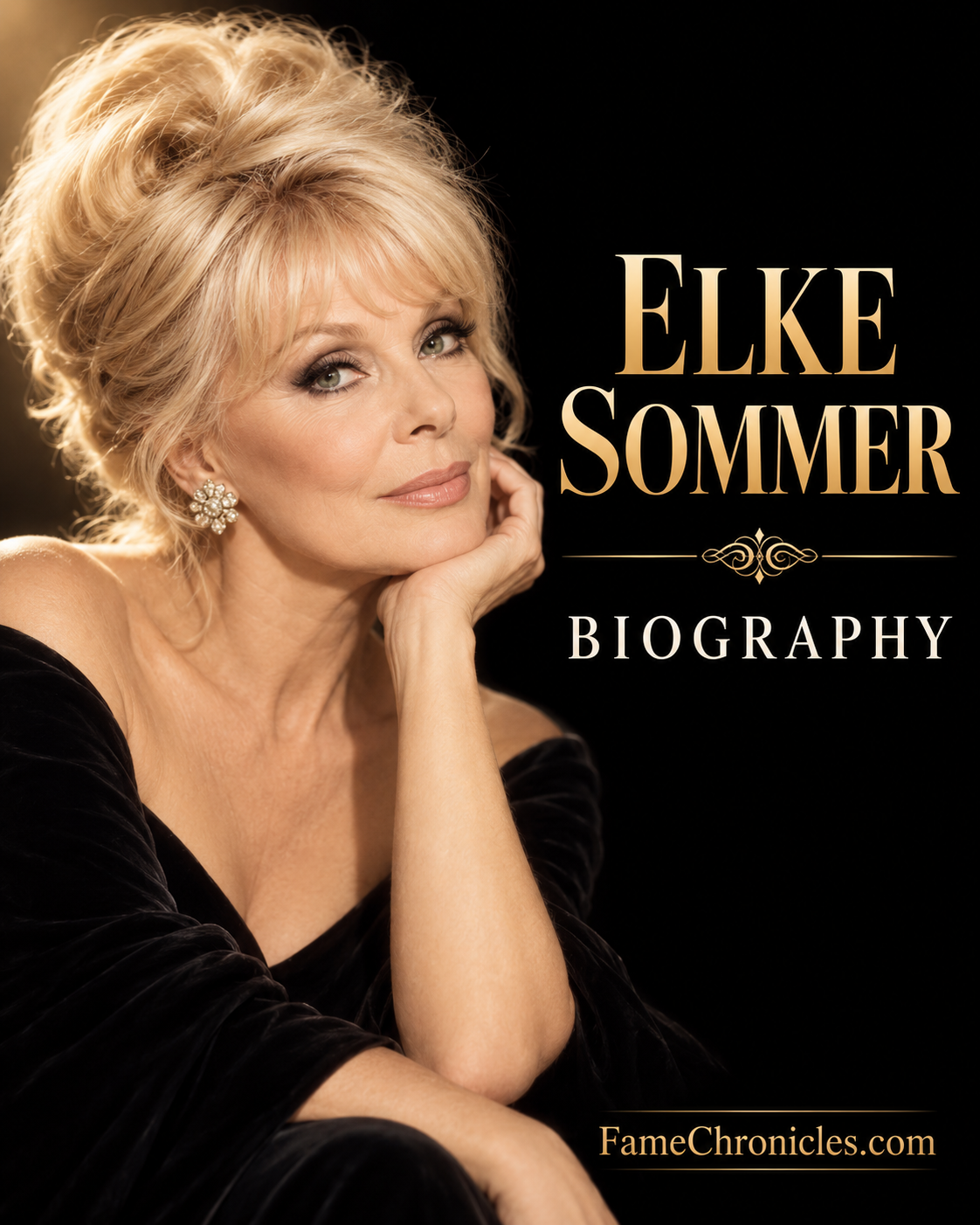
Elke Sommer was a German actress and painter who became an international film star during the 1960s. She appeared opposite performers including Paul Newman and Peter Sellers, moving between European productions and Hollywood comedies, dramas, and thrillers. Her roles in The Prize and A Shot in the Dark remain among her best-known screen appearances.
Sommer died at her home in Bel Air, Los Angeles, on October 28, 2026, at age 85, just days before her 86th birthday. Her death was reported by her stepson; a cause of death was not announced in the reports available at publication. Associated Press
Elke Sommer quick facts
| Detail | Information |
|---|---|
| Birth name | Elke Schletz |
| Born | November 5, 1940 |
| Birthplace | Berlin, Germany |
| Died | October 28, 2026 |
| Age at death | 85 |
| Nationality | German |
| Professions | Actress and painter |
| First film | The Friend of the Jaguar |
| Hollywood breakthrough | The Prize |
| Best-known comedy | A Shot in the Dark |
| Award | Golden Globe for Most Promising Newcomer |
| First husband | Joe Hyams |
| Second husband | Wolf Walther |
| Notable voice role | Yzma in the German version of The Emperor’s New Groove |
Who was Elke Sommer?
Elke Sommer was the screen name of Elke Schletz, a German performer whose career took her from European films to Hollywood productions. She was known for a poised screen presence and for working across several genres. While her appearance received considerable attention in the publicity culture of the era, her filmography also included comedies, suspense films, dramas, horror, and voice work.
Sommer’s career was built across borders. She worked in films made in Italy, Germany, Britain, and the United States, often performing in productions with international casts. Her success came during a period when European actors were increasingly appearing in American studio films, and she became one of the German-born performers recognized by U.S. audiences.
Early life and move toward acting
Sommer was born in Berlin on November 5, 1940, during the Second World War. Her father was a Protestant pastor. In 1942, the family evacuated to southern Germany, where she spent much of her childhood. Her father died when she was 14. Associated Press
She initially had plans beyond acting and was interested in studying languages. A trip to Italy with her mother in 1958 changed the direction of her life. During that visit, she was noticed by people working in the Italian film industry and invited to appear in a movie. She adopted the stage surname “Sommer,” meaning “summer” in German, and began taking film roles.
Her first screen appearance was in the Italian film The Friend of the Jaguar (L’amico del giaguaro), released in 1958. Actor and director Vittorio De Sica also noticed her, and she continued working in European cinema. The film database Filmportal records her early career and later work in German productions. Filmportal
European films and the road to Hollywood
Before becoming a familiar face in Hollywood, Sommer developed her career through European film productions. She worked in Italy, Spain, Germany, and England, gaining experience in different styles of filmmaking. Her screen name helped create a memorable identity for international audiences, while her multilingual background supported work across national film industries.
Her major American breakthrough came with The Prize (1963), a drama starring Paul Newman. Sommer played a character who becomes involved with Newman’s Nobel Prize-winning writer. The film introduced her to a much wider U.S. audience and led to a Golden Globe Award for Most Promising Newcomer. The recognition helped establish her as a promising international performer in Hollywood. Associated Press
That award did not define the rest of her career by itself. Sommer went on to work with well-known actors and filmmakers in a range of productions. Her roles could be glamorous, comic, mysterious, or dramatic, and she was often asked to carry an important supporting part in films built around larger ensemble casts.
A Shot in the Dark and Hollywood recognition
One of Sommer’s most recognizable roles was Maria Gambrelli in A Shot in the Dark (1964), the Pink Panther comedy starring Peter Sellers as Inspector Jacques Clouseau. Her character is a maid accused of murder, and the investigation turns into a comic chain of misunderstandings and suspicion.
The film became a major part of her public image. It also showed her ability to play comedy opposite Sellers, whose performance was deliberately eccentric and physical. Sommer’s character had to remain composed within the chaos of Clouseau’s investigation, creating a contrast that helped the movie’s humor.
She also appeared in The Art of Love with James Garner and Dick Van Dyke, Boy, Did I Get a Wrong Number! with Bob Hope, and The Wrecking Crew, which featured Dean Martin and Sharon Tate. Those projects placed her among the international performers working regularly in American studio films during the decade. Associated Press
Although headlines often emphasized her beauty and screen glamour, Sommer later pushed back against being reduced to a label. In an interview cited by the Associated Press, she described herself as an actor performing written characters and said energy was what she brought to a role. Her remarks reflected a tension familiar to many actresses of the period: the publicity machine could focus on appearance even when the performers wanted their craft recognized.
Later film work and European projects
Sommer’s career continued after the height of her 1960s Hollywood visibility. During the 1970s, she appeared in European productions, including the First World War film Zeppelin and the Agatha Christie adaptation And Then There Were None. She also worked in horror films, including projects directed by Mario Bava.
Her later filmography was less centered on Hollywood studio movies, but she remained active in acting and continued to take roles that suited her interests. She appeared in German productions and made occasional screen appearances over the following decades. This later period is an important part of her career because it shows that she did not simply disappear after her best-known American films.
Sommer also worked as a voice actor. In the German-language version of Disney’s The Emperor’s New Groove, she voiced Yzma, the film’s sharp-tongued antagonist. The role introduced her voice to another generation of viewers, including audiences who might not have known her earlier live-action films.
Painting and creative life beyond acting
Sommer was also a painter. By the 1990s, she had turned more of her attention to visual art, while still making occasional appearances in film and television. Painting offered a separate creative outlet from acting and allowed her to work outside the demands of film sets, publicity, and performance schedules.
Her artistic life was part of a broader identity that could be missed when coverage focused only on her screen image. She was not simply a Hollywood performer from the 1960s; she was a German artist with a career that moved across film, voice acting, and painting.
Personal life
Sommer married American columnist and screenwriter Joe Hyams in November 1964. The couple divorced in 1981. In 1993, she married German hotelier Wolf Walther. Walther died in July 2026, a few months before Sommer. Associated Press
She generally kept much of her private life separate from her public career. One highly publicized episode was a legal dispute with Zsa Zsa Gabor and Gabor’s husband, Frédéric Prinz von Anhalt. Sommer sued them for defamation after remarks about her were published in the German media. In 1993, a jury awarded Sommer $3.3 million. The episode became part of the press coverage surrounding her, though it was separate from her acting work.
Elke Sommer’s death and legacy
Elke Sommer died at her home in Bel Air on October 28, 2026, aged 85. The announcement came shortly before what would have been her 86th birthday. At the time this article was prepared, reports had not stated a cause of death. Associated Press
Her legacy rests on more than a single film or image. She was among the German performers who built an international career during the postwar decades, moving from European cinema into American productions. Her performances alongside Paul Newman, Peter Sellers, Bob Hope, and other stars made her familiar to audiences across several countries.
The range of her work is also part of her story. She moved between comedy, drama, suspense, horror, voice acting, and painting. A Shot in the Dark remains a classic comedy, while her Golden Globe-winning performance in The Prize marked a turning point in her U.S. career. For audiences discovering her work now, those films offer an entry point into a much wider filmography.
Sommer’s career also illustrates how Hollywood publicity could shape a performer’s public identity. She was often marketed through glamour, but her work spanned decades and continents. Remembering her as an actor and painter gives a fuller picture of the person behind the familiar screen image.
Frequently asked questions
How old was Elke Sommer when she died?
Elke Sommer was 85. She was born on November 5, 1940, and died on October 28, 2026.
What was Elke Sommer’s real name?
Her birth name was Elke Schletz. She used Elke Sommer as her professional name.
What movies was Elke Sommer known for?
She was known for The Prize, A Shot in the Dark, The Art of Love, Boy, Did I Get a Wrong Number!, and The Wrecking Crew, among other films.
Did Elke Sommer win a Golden Globe?
Yes. She received the Golden Globe for Most Promising Newcomer for her role in The Prize.
Was Elke Sommer a painter?
Yes. Alongside acting, Sommer painted and devoted more attention to visual art later in her life.
What was Elke Sommer’s role in The Emperor’s New Groove?
She voiced Yzma in the German-language version of the animated film.
What was Elke Sommer’s cause of death?
A cause of death had not been publicly stated in the reports available when this article was written.
Final Word
Elke Sommer built an international career that reached from European cinema to Hollywood and back again. Her roles in The Prize and A Shot in the Dark made her widely recognized, while her later work in European films, voice acting, and painting showed the range of her creative life. Her legacy is best understood through that full journey, not only through the glamour image often attached to her name.