

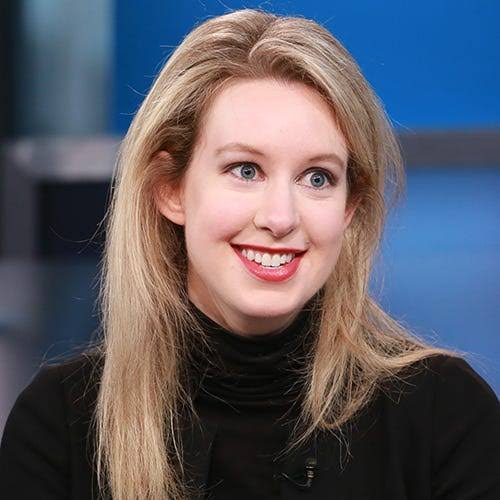
Elizabeth Holmes is an American former business executive who founded Theranos, a health technology company that claimed it could run many laboratory tests using only a small amount of blood. The company attracted major investors and public attention before investigations revealed that its testing technology did not perform as promised. Holmes was convicted of defrauding investors and sentenced to federal prison.
The Theranos story became one of the most closely followed corporate scandals in recent U.S. history. It raised questions about the responsibilities of startup founders, the role of investors and boards, the verification of medical technology, and the risks of treating ambitious claims as proven results.
As of October 2026, Holmes is serving a prison sentence in Texas. Recent reporting says a judge reduced her sentence from 135 months to 123 months under revised federal sentencing guidelines. She is scheduled to move to a Texas halfway house in August 2027, while her conviction remains in place.
Elizabeth Holmes: Quick Facts
| Detail | Information |
|---|---|
| Full name | Elizabeth Anne Holmes |
| Born | February 3, 1984 |
| Known for | Founding and leading Theranos |
| Company founded | Theranos, established in 2003 |
| Education | Attended Stanford University; left before earning a degree |
| Conviction | Four counts of wire fraud and conspiracy related to investors |
| Original sentence | 135 months in federal prison, imposed in 2022 |
| Sentence update | Reduced to 123 months in March 2026, according to recent reporting |
| Prison status | Serving her sentence in Texas as of October 2026 |
Early Life and Education
Holmes was born in Washington, D.C., and grew up in the United States. She enrolled at Stanford University in 2002, studying chemical engineering. While still a student, she became interested in developing medical technology that might make diagnostic testing more convenient and accessible.
In 2003, at age 19, Holmes left Stanford and founded a company initially called Real-Time Cures. It was later renamed Theranos, a name combining the ideas of therapy and diagnosis. Holmes chose to focus on blood testing, a field where she believed technology could make laboratory tests faster and easier for patients.
Founding Theranos
Theranos promoted the idea that it could conduct a broad range of blood tests using only a few drops collected from a finger prick. The company said its approach could make testing less invasive and potentially more convenient than traditional blood draws. It aimed to offer testing through retail locations and partnerships.
Holmes became the company’s public face and attracted attention from investors and prominent business and political figures. Theranos was often presented as a highly ambitious startup with the potential to transform medical testing. At its height, the company received a multibillion-dollar valuation and drew substantial investment.
But the company’s public claims became a central point of scrutiny. The U.S. Securities and Exchange Commission said Holmes and Theranos made false or misleading statements to investors about the company’s technology, business relationships, and financial performance. In 2018, the SEC charged Holmes and former Theranos president Ramesh “Sunny” Balwani with raising more than $700 million from investors through what it described as a years-long fraud. Holmes settled the SEC civil charges without admitting or denying the allegations.
Questions About the Blood-Testing Technology
Theranos’s business depended on the claim that its proprietary analyzers could perform many tests from a small blood sample. Questions arose about whether the company’s devices could reliably do what its marketing suggested. Reporting and regulatory scrutiny brought attention to the reliability of test results and the extent to which Theranos used its own technology for patient testing.
The controversy was consequential because blood-test results can affect medical decisions. A test that is inaccurate or unreliable can lead to confusion, unnecessary follow-up, or missed diagnoses. The case therefore involved more than a dispute between a company and investors; it raised public concerns about patient safety and the oversight of health technology.
Theranos ultimately stopped operating its laboratory testing service and dissolved. The company’s collapse followed years of disputes over whether its technology worked at the scale and accuracy its leaders had claimed.
Criminal Investigation and Trial
Federal prosecutors brought criminal charges against Holmes and Balwani. Holmes’s trial began in 2021 in federal court in San Jose, California. Prosecutors argued that she knowingly misrepresented Theranos’s technology and business to investors. The defense disputed the government’s case and challenged how responsibility for the company’s claims was assigned.
In January 2022, a jury found Holmes guilty of three counts of wire fraud and one count of conspiracy to commit wire fraud related to investors. The jury did not reach unanimous verdicts on several other investor counts, and Holmes was acquitted of charges connected to patients. The distinction matters: the convictions concerned investor fraud, not a conviction for defrauding patients.
In November 2022, the court sentenced Holmes to 135 months—11 years and three months—in federal prison. The judge also ordered three years of supervision after release. In 2023, the court ordered Holmes and Balwani to pay $452 million in restitution to investors. The restitution order was later upheld along with the convictions.
Appeals and Current Sentence
Holmes appealed her conviction and sentence. In February 2025, the Ninth Circuit Court of Appeals upheld the convictions and sentence. The court denied a further rehearing request later that year, leaving the fraud convictions intact.
In March 2026, a federal judge reduced Holmes’s prison term from 135 months to 123 months under revised sentencing guidelines for certain first-time offenders, according to Axios’s October 2026 reporting. The reduction changed the length of the sentence but did not overturn the convictions.
As of October 2026, Holmes is serving her sentence at a minimum-security federal prison in Bryan, Texas. She is scheduled to transfer to a halfway house in Del Valle, Texas, in August 2027. A halfway-house placement allows more access to work, counseling, and visits, while the person remains under federal supervision. The reported projected release date is February 22, 2030; release calculations can change, so this date should be checked against current Bureau of Prisons records before publication.
Holmes has also sought clemency from President Donald Trump, according to recent reporting. A clemency request is separate from an appeal and does not itself change a sentence. As of the latest available reporting cited here, the request had not resulted in her release.
Theranos Case: Key Events
| Year | Event | What happened |
|---|---|---|
| 2003 | Company founded | Holmes left Stanford and established the company that became Theranos. |
| 2013 onward | Company gains public attention | Theranos promoted its blood-testing technology and pursued retail partnerships. |
| 2015–2016 | Technology under scrutiny | Investigations and regulatory actions intensified questions about the tests and company claims. |
| 2018 | SEC charges | The SEC charged Holmes and Theranos with misleading investors; Holmes settled the civil case without admitting or denying the allegations. |
| 2021 | Criminal trial | Holmes’s federal fraud trial began in California. |
| January 2022 | Jury verdict | Holmes was convicted on three wire-fraud counts and one conspiracy count related to investors. |
| November 2022 | Sentencing | She received a 135-month federal prison sentence. |
| May 2023 | Reports to prison | Holmes began serving her sentence in Texas. |
| February 2025 | Appeal denied | The Ninth Circuit upheld her convictions and sentence. |
| March 2026 | Sentence reduced | A judge reduced the term to 123 months, according to October 2026 reporting. |
| August 2027 | Planned halfway-house transfer | Recent reporting says Holmes is scheduled to move to a Texas halfway house. |
Public Image and Legacy
During Theranos’s rise, Holmes was often portrayed as a bold young founder pursuing a major medical innovation. Her public image, including her dark clothing and reserved manner, became part of the company’s story. After the company’s collapse and her conviction, discussion of her career shifted toward corporate governance, scientific validation, and the risks of exaggerating what a product can do.
The Theranos case is now frequently used as a cautionary example in conversations about startups and health technology. It illustrates why claims involving medical testing require careful scientific validation and independent oversight. It also underscores the importance of investors, board members, journalists, regulators, and employees asking for evidence before accepting a company’s claims.
Holmes’s case also prompted debate about leadership accountability and gender in business. Some commentary focused on how media coverage treated Holmes compared with male founders, while other analysis centered on the evidence presented at trial and the specific conduct for which she was convicted. A balanced account should distinguish those broader discussions from the jury’s verdict and court rulings.
Frequently Asked Questions
Who is Elizabeth Holmes?
Elizabeth Holmes is the founder and former CEO of Theranos, a health technology company that claimed it could run many blood tests using small samples. She was convicted of investor fraud in 2022.
What was Theranos?
Theranos was a startup founded by Holmes in 2003. It aimed to change laboratory testing with technology that it said could run many tests from a small amount of blood. The company later collapsed after questions about its technology and business claims.
What was Elizabeth Holmes convicted of?
A jury convicted Holmes of three counts of wire fraud and one count of conspiracy to commit wire fraud involving investors. She was acquitted of charges related to patients, and the jury did not reach verdicts on some other counts.
How long was Elizabeth Holmes sentenced to prison?
She was originally sentenced to 135 months, or 11 years and three months, in 2022. A judge reduced the sentence to 123 months in March 2026, according to recent reporting.
Where is Elizabeth Holmes now?
As of October 2026, she is serving her sentence at a federal prison in Bryan, Texas. She is reportedly scheduled to transfer to a halfway house in Del Valle, Texas, in August 2027.
When is Elizabeth Holmes expected to be released?
Axios reported an expected release date of February 22, 2030, following a sentence reduction. Projected release dates can change, so verify the latest Bureau of Prisons information before relying on that date.
Did Elizabeth Holmes graduate from Stanford?
No. Holmes attended Stanford University but left before completing a degree to start the company that became Theranos.
Final Word
Elizabeth Holmes’s rise and fall at Theranos became a defining story about ambition, evidence, and accountability in Silicon Valley. The company promised to simplify blood testing, but its claims did not match what its technology could reliably deliver. Holmes was convicted of defrauding investors and remains in federal custody. Her story continues to shape discussions about startup governance, medical innovation, and the need to verify claims that can affect people’s health and finances.